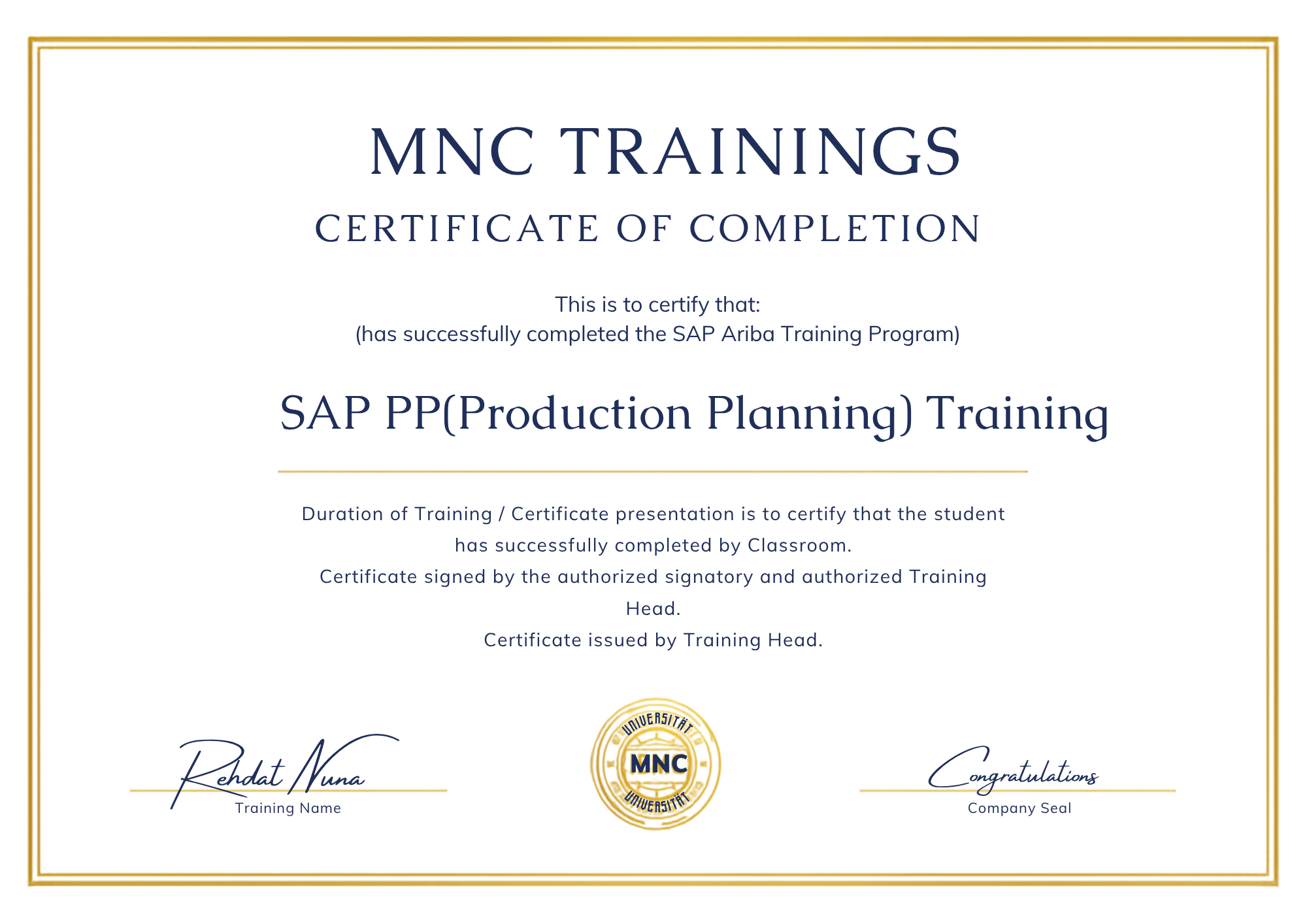
SAP PP Training
SAP PP Course
- 40 Hours Live Training Sessions & 5+ Softskill Classes
- 14+ Hours Project Practice & 38+ Assignments Modules
- 100+ Mock MCQs & 10+ Hours SAP PP Exam Assistance
★ ★ ★ ★ ★ 4.9 (1931 Ratings)

Our Exclusive Course Offerings
Up skilling
Develop & reinforce skill set with upskilling aligned to your development plans offered during training
GCAO Training Model
Training Agenda is prepared post intensive training need analysis to ensure High ROI & Training Objective is met
JOB Opportunities
Crack 40,000+ SAP Job Vacancies for Experienced & Freshers certified SAP ARIBA professionals in US, & Middle East
10+ Webinars
Regular concept brush-up webinars conducted for SAP ARIBA Training Course
Comprehensive Curriculum
Follow the SAP Certification Curriculum designed in accordance with Industry needs
Experienced & Certified Trainers
Learn from Certified Trainers having 10+Years of Training Implementation Experience
Our Student Reviews
Our Course Detailed Overview
Module 1: Introduction to SAP PP
Module 1 provides an overview of SAP Production Planning (PP) and manufacturing processes. Students will learn how SAP PP supports production planning, execution, and control.
Lessons
● Introduction to SAP ERP and SAP S/4HANA
● Overview of SAP PP Module
● Manufacturing Process Overview
● Enterprise Structure in SAP PP
● Production Planning Concepts
● Master Data Overview
● Integration with Other SAP Modules
● SAP Navigation Basics
● Production Lifecycle Management
● Production Reporting Overview
After completing this module, students will be able to:
● Understand SAP PP architecture and manufacturing processes.
● Configure organizational structure components.
● Navigate SAP PP transactions.
● Understand production planning concepts.
Module 2: Material Master and Master Data
Module 2 covers the master data required for production planning and execution.
Lessons
● Material Master Records
● Bill of Materials (BOM)
● Work Centers
● Routing Configuration
● Production Versions
● Resource Management
● Classification and Characteristics
● Engineering Change Management
● Master Data Validation
● Master Data Best Practices
After completing this module, students will be able to:
● Create and maintain production master data.
● Configure BOMs and Routings.
● Manage work centers effectively.
● Support production planning activities.
Module 3: Demand Management
Module 3 introduces forecasting and demand planning processes.
Lessons
● Demand Management Overview
● Planned Independent Requirements (PIR)
● Forecasting Techniques
● Requirement Strategies
● Demand Program Management
● Sales and Operations Planning
● Consumption Management
● Planning Scenarios
● Demand Reporting
● Forecast Accuracy Analysis
After completing this module, students will be able to:
● Manage demand planning processes.
● Create and maintain forecasts.
● Configure planning strategies.
● Analyze demand requirements.
Module 4: Material Requirements Planning (MRP)
Module 4 focuses on planning material availability for production.
Lessons
● Introduction to MRP
● MRP Parameters
● Planning Run Execution
● Planned Orders
● Procurement Proposals
● Capacity Planning Basics
● MRP Exception Messages
● MRP Evaluation Reports
● Planning Optimization
● MRP Best Practices
After completing this module, students will be able to:
● Execute MRP runs successfully.
● Analyze planning results.
● Generate procurement proposals.
● Ensure material availability for production.
Module 5: Production Orders
Module 5 explains the creation and management of production orders.
Lessons
● Production Order Creation
● Order Release Process
● Component Availability Check
● Scheduling Production Orders
● Capacity Evaluation
● Production Confirmation
● Goods Receipt Processing
● Order Settlement
● Order Status Management
● Production Order Reporting
After completing this module, students will be able to:
● Create and manage production orders.
● Schedule manufacturing activities.
● Confirm production operations.
● Monitor order execution effectively.
Module 6: Capacity Planning
Module 6 focuses on balancing production demand and available resources.
Lessons
● Capacity Planning Concepts
● Capacity Requirements Planning
● Work Center Capacity Management
● Capacity Evaluation Reports
● Capacity Leveling Techniques
● Resource Optimization
● Shift Planning
● Bottleneck Analysis
● Capacity Monitoring
● Capacity Planning Best Practices
After completing this module, students will be able to:
● Plan production capacity effectively.
● Identify resource constraints.
● Optimize manufacturing resources.
● Monitor production workloads.
Module 7: Production Execution and Shop Floor Control
Module 7 covers production execution activities and shop floor management.
Lessons
● Shop Floor Control Overview
● Production Confirmation
● Time Ticket Confirmation
● Backflushing Process
● Goods Movements
● Rework Processing
● Scrap Management
● Production Monitoring
● Quality Integration Basics
● Shop Floor Reporting
After completing this module, students will be able to:
● Manage production execution processes.
● Monitor shop floor activities.
● Record production confirmations.
● Improve manufacturing efficiency.
Module 8: SAP PP Reporting and Integration
Module 8 explains reporting capabilities and integration with other SAP modules.
Lessons
● Standard SAP PP Reports
● Production Analytics
● Capacity Reports
● Order Reports
● SAP Fiori Applications
● Integration with SAP MM
● Integration with SAP QM
● Integration with SAP FI/CO
● Custom Reporting Basics
● Manufacturing Performance Analysis
After completing this module, students will be able to:
● Generate production planning reports.
● Analyze manufacturing performance.
● Understand SAP PP integration.
● Utilize reporting tools effectively.
Module 9: SAP PP Best Practices and Real-Time Scenarios
Module 9 focuses on industry best practices, implementation approaches, and project scenarios.
Lessons
● End-to-End Manufacturing Cycle
● Production Planning Best Practices
● Data Migration Concepts
● SAP S/4HANA PP Features
● Troubleshooting Production Issues
● Performance Optimization Techniques
● Audit and Compliance Requirements
● Real-Time Project Scenarios
● Interview Preparation
● Certification Guidance
After completing this module, students will be able to:
● Apply SAP PP best practices.
● Handle real-world manufacturing scenarios.
● Support SAP PP implementations.
● Prepare for SAP PP certification and job interviews.