
SAP ABAP Training
SAP ABAP Course
- 40 Hours Live Training Sessions & 5+ Softskill Classes
- 14+ Hours Project Practice & 38+ Assignments Modules
- 100+ Mock MCQs & 10+ Hours SAP ABAP Exam Assistance
★ ★ ★ ★ ★ 4.9 (1931 Ratings)

Our Exclusive Course Offerings
Up skilling
Develop & reinforce skill set with upskilling aligned to your development plans offered during training
GCAO Training Model
Training Agenda is prepared post intensive training need analysis to ensure High ROI & Training Objective is met
JOB Opportunities
Crack 40,000+ SAP Job Vacancies for Experienced & Freshers certified SAP ARIBA professionals in US, & Middle East
10+ Webinars
Regular concept brush-up webinars conducted for SAP ARIBA Training Course
Comprehensive Curriculum
Follow the SAP Certification Curriculum designed in accordance with Industry needs
Experienced & Certified Trainers
Learn from Certified Trainers having 10+Years of Training Implementation Experience
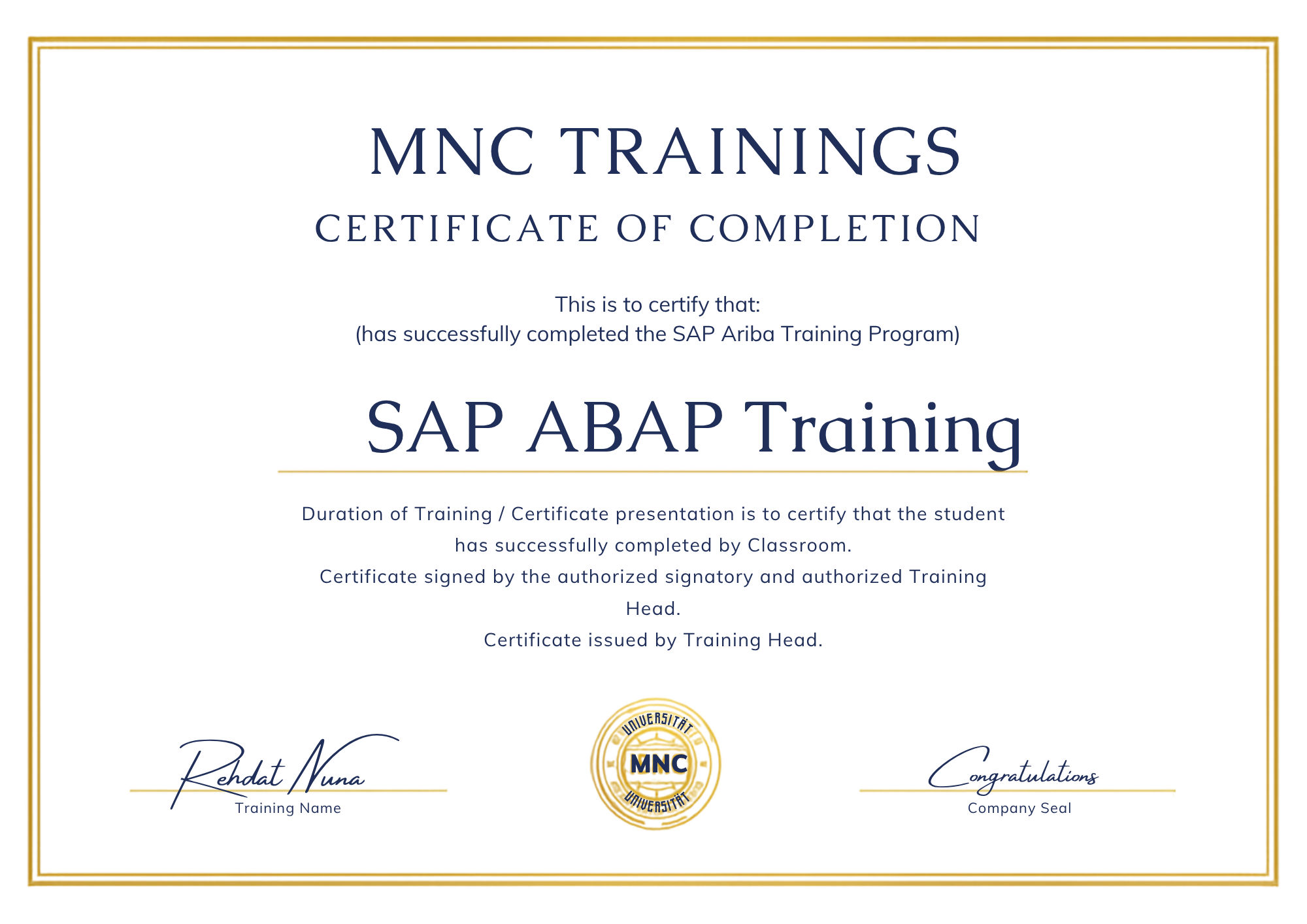
Our Student Reviews
Our Course Detailed Overview
Module 1: Introduction to SAP ABAP and SAP Architecture
Module 1 provides an overview of SAP ERP architecture, SAP NetWeaver, and the ABAP programming environment. Students will learn the fundamentals of SAP application development and ABAP programming concepts.
Lessons
- Introduction to SAP ERP and SAP S/4HANA
- Understanding SAP Architecture
- Introduction to SAP ABAP
- SAP GUI Navigation
- SAP Development Landscape
- ABAP Workbench Overview
- SAP Transport Management System
- Development Tools and Utilities
- Introduction to SAP Database Concepts
- ABAP Development Lifecycle
After completing this module, students will be able to:
- Understand SAP system architecture.
- Navigate SAP development environments.
- Understand the role of ABAP in SAP applications.
- Configure basic development settings.
Module 2: ABAP Workbench and Development Environment
Module 2 covers the ABAP Workbench tools and development environment used for creating, managing, and testing SAP applications.
Lessons
- Introduction to ABAP Workbench
- Object Navigator (SE80)
- ABAP Editor
- Package Management
- Repository Browser
- Transport Requests
- Version Management
- Development Objects
- Debugging Basics
- Development Standards
After completing this module, students will be able to:
- Navigate the ABAP Workbench.
- Create and manage development objects.
- Use transport management.
- Perform basic debugging tasks.
Module 3: ABAP Programming Fundamentals
Module 3 introduces the fundamental concepts of ABAP programming, including data types, variables, operators, and control structures.
Lessons
- ABAP Syntax Basics
- Data Types and Variables
- Constants and Operators
- Conditional Statements
- Looping Statements
- Internal Tables
- Structures
- String Operations
- Error Handling
- Program Execution
After completing this module, students will be able to:
- Write basic ABAP programs.
- Work with variables and data types.
- Implement program logic.
- Handle errors effectively.
Module 4: SAP Data Dictionary and Database Programming
Module 4 covers SAP Data Dictionary objects and database programming techniques used for managing SAP data.
Lessons
- Introduction to SAP Data Dictionary
- Domains and Data Elements
- Database Tables
- Views
- Search Helps
- Lock Objects
- Open SQL
- Database Joins
- Transactions
- Performance Optimization
After completing this module, students will be able to:
- Create Data Dictionary objects.
- Develop database programs.
- Manage SAP data structures.
- Optimize database performance.
Module 5: Report Programming and ALV Reports
Module 5 focuses on report development techniques and the creation of ALV reports for business reporting requirements.
Lessons
- Classical Reports
- Interactive Reports
- Event Processing
- Selection Screens
- Report Formatting
- ALV Fundamentals
- ALV Grid Reports
- ALV Tree Reports
- Report Variants
- Performance Tuning
After completing this module, students will be able to:
- Develop SAP reports.
- Create ALV reports.
- Design interactive reporting solutions.
- Optimize report performance.
Module 6: Modularization Techniques and Function Modules
Module 6 introduces modular programming concepts and reusable development techniques in SAP ABAP.
Lessons
- Modularization Concepts
- Subroutines
- Includes
- Function Modules
- Function Groups
- Parameter Passing
- Exception Handling
- Reusable Components
- RFC Concepts
- BAPI Overview
After completing this module, students will be able to:
- Develop reusable components.
- Create function modules.
- Implement modular programming.
- Build scalable applications.
Module 7: Dialog Programming and Module Pool Programming
Module 7 covers the development of interactive SAP applications using screens and dialog programming techniques.
Lessons
- Introduction to Dialog Programming
- Module Pool Programming
- Screen Painter
- Menu Painter
- Screen Flow Logic
- PBO and PAI Events
- Table Controls
- Tabstrip Controls
- Message Handling
- Debugging Dialog Programs
After completing this module, students will be able to:
- Develop SAP dialog applications.
- Create interactive screens.
- Implement user interactions.
- Troubleshoot dialog programs.
Module 8: SAP Forms, Interfaces, and Integration
Module 8 provides an overview of SAP forms, interface technologies, and integration methods used in SAP environments.
Lessons
- SAP Scripts
- Smart Forms
- Adobe Forms
- ALE Concepts
- IDocs
- RFC
- BAPIs
- OData Services
- Web Services
- Integration Monitoring
After completing this module, students will be able to:
- Create SAP forms.
- Develop SAP interfaces.
- Integrate SAP systems.
- Monitor integration processes.
Module 9: Object-Oriented ABAP and SAP HANA Development
Module 9 introduces advanced ABAP concepts, including object-oriented programming, enhancement techniques, and SAP HANA development.
Lessons
- Introduction to Object-Oriented ABAP
- Classes and Objects
- Inheritance
- Polymorphism
- Interfaces
- User Exits
- BADIs
- CDS Views
- AMDP
- ABAP on HANA
After completing this module, students will be able to:
- Develop object-oriented applications.
- Implement enhancement techniques.
- Utilize SAP HANA capabilities.
- Build advanced SAP solutions.